
Battery Energy Storage Systems (BESS) have rapidly evolved from an expensive niche technology into a mainstream asset class within modern power systems. But a fundamental question persists for investors, utilities, and project developers: how does a BESS actually generate revenue? Unlike a traditional power plant that sells the electricity it generates, a BESS is essentially an intermediary—it buys electricity, stores it, and sells it later. Its profitability hinges on the timing and location of that arbitrage, as well as on a range of ancillary services that only a fast-responding battery can provide.
Below is a detailed breakdown of the primary revenue streams for a grid-scale BESS.
1. The Core Business Model
Energy arbitrage is the most intuitive way a BESS makes money. Wholesale electricity prices are not constant; they fluctuate based on supply and demand. Prices typically drop during periods of low demand (e.g., overnight, sunny afternoons with high solar output) and spike during periods of high demand (e.g., early evening when solar fades and people return home).
The BESS operator buys electricity when prices are low, stores it in the batteries, and sells it back to the grid when prices are high. The revenue is the difference between the selling price and the purchase price, multiplied by the amount of energy discharged, minus the round-trip efficiency losses (typically 10-15%). This strategy is also known as price arbitrage or time-shifting.
Example:
A BESS buys electricity at 20permegawatt−hour(MWh)at2:00AMandsellsitat120 per MWh at 7:00 PM. The gross margin is 100perMWh.Fora100MWhsystem,asingledailycyclecouldgenerate10,000 in gross revenue before operational costs.
However, arbitrage alone is rarely sufficient to achieve attractive returns. The price spread must be large enough and frequent enough to justify the capital investment.
2. Frequency Regulation: The High-Value Service
Frequency regulation is often the most lucrative revenue stream for BESS, especially in markets with well-developed ancillary service mechanisms. Power grids must maintain a precise frequency (e.g., 50 Hz or 60 Hz). Any imbalance between generation and demand causes frequency to drift. Grid operators procure fast-responding resources to correct these deviations.
BESS is exceptionally well-suited for this task because batteries can respond in milliseconds—far faster than thermal power plants, which may take minutes. The BESS essentially acts as a rapid-response shock absorber. It charges slightly (absorbs excess power) when frequency is too high and discharges (injects power) when frequency is too low.
Payment for frequency regulation is typically based on capacity (being available to respond) and performance (how quickly and accurately the system responds). Since frequency regulation involves only small, rapid movements of energy, the battery does not need to fully cycle from empty to full. This minimizes degradation while generating steady revenue.
3. Operating Reserves (Spinning and Non-Spinning)
Similar to frequency regulation, operating reserves are backup capacity that grid operators keep ready to respond to unexpected events—such as the sudden outage of a large power plant or a transmission line. Reserves are typically categorized as:
- Spinning reserves: Synchronized to the grid and can respond within 10 minutes.
- Non-spinning reserves: Offline but can start and ramp up within 10 minutes.
- Supplemental or contingency reserves: Respond within 30 minutes.
A BESS can provide both spinning and non-spinning reserves. The operator is paid a capacity payment simply for being available with a certain amount of standby power. If the reserve is actually called upon, the BESS receives additional energy payments. Because reserve events are relatively rare, the battery can offer most of its capacity for reserves while still performing other services when not on standby.
4. Capacity Markets: Getting Paid for Readiness
Grid operators in deregulated markets (e.g., PJM, UK) hold capacity auctions to secure future peak demand. Resources that commit to availability receive fixed payments, regardless of energy delivery.
BESS can participate in capacity markets by promising to deliver a certain amount of power during peak hours. The revenue is predictable and contract-like, making it attractive for project financing. However, capacity markets are being reformed in some regions to ensure that batteries can deliver sustained energy (not just short bursts), which has historically been a challenge for storage with limited duration (e.g., 1-2 hour systems).
5. Peak Shaving and Demand Charge Reduction
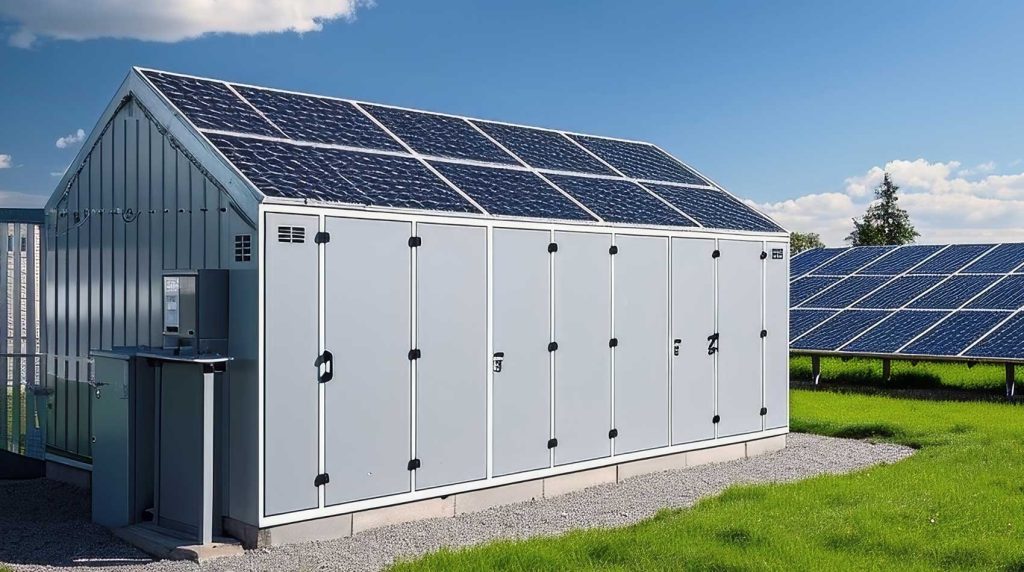
Behind-the-meter BESS reduces peak demand charges for C&I customers, which are based on the highest 15- or 30-minute power draw each month.
A BESS can “shave” these peaks by discharging during brief periods of high demand, thereby reducing the customer’s peak draw. The savings are direct reductions in the monthly demand charge. For a factory with a highly variable load, demand charges can account for 30-50% of the electricity bill, making peak shaving a compelling business case.
Unlike market-facing revenue streams, peak shaving generates savings, not revenue. But from a financial perspective, a dollar saved is a dollar earned.
6. Renewable Integration and Firming
As solar and wind penetration grows, grid operators face challenges with renewable intermittency. A BESS paired with a solar or wind farm can “firm” the output—smoothing the ramp rates and shifting generation to more valuable hours.
The BESS can make money by:
- Reducing curtailment: When renewable generation exceeds grid demand, prices may go negative. The BESS charges instead of the renewable plant being forced offline.
- Shifting to higher-value hours: Solar production peaks at midday when prices are often low due to oversupply. The BESS stores that solar energy and sells it during the evening peak when prices are high.
In many cases, the revenue from renewable firming is captured by the renewable asset owner, who can then sell a “shaped” or “dispatchable” renewable product at a premium.
7. Black Start and Voltage Support
In some markets, BESS is also compensated for providing specialized grid services:
- Black start: The ability to restart a grid segment after a complete blackout without relying on external power. Traditionally provided by diesel generators or hydro plants.
- Voltage support (VAR control): Using the battery inverter to inject or absorb reactive power, helping maintain voltage stability on transmission and distribution networks.
These services are often procured via long-term contracts and represent niche but valuable revenue opportunities.
8. Stacking Revenue Streams: The Key to Profitability
The most important concept in BESS economics is revenue stacking. No single revenue stream is typically sufficient to justify a BESS investment. Instead, sophisticated operators use software and algorithms to combine multiple services, either sequentially or simultaneously.
For example, a BESS might:
- Reserve 10% of its capacity for frequency regulation (a high-value, 24/7 service).
- Use 80% of its capacity for energy arbitrage (one full cycle per day).
- Offer the remaining 10% as spinning reserves (which are rarely called).
- Collect capacity market payments for being available during peak months.
Advanced energy management systems (EMS) and real-time market data allow the BESS to dynamically switch between revenue streams within seconds, optimizing for the highest possible combined return. This ability to “multitask” is what makes modern BESS so valuable compared to single-purpose assets like peaker plants.
9. Challenges and Risks Affecting Profitability
While the revenue opportunities are substantial, several factors erode actual profits:
- Round-trip efficiency: 10-15% of energy is lost in each cycle.
- Battery degradation: Each cycle reduces total capacity and lifespan (typically 10-20 years). More aggressive cycling generates more revenue but shortens asset life.
- Market saturation: As more BESS projects come online, price spreads compress and ancillary service prices fall.
- Duration limitations: A 1-hour battery cannot sustain discharge long enough to capture multi-hour price peaks. Longer duration (2-4 hours) is becoming standard.
- Basis risk: Locational price differences between the charging node and discharging node can reduce arbitrage profits.
Conclusion
A BESS makes money not by generating energy, but by moving energy across time and providing speed-driven services that traditional generators cannot match. Its revenue stack includes energy arbitrage, frequency regulation, operating reserves, capacity market payments, demand charge reduction, and renewable firming.
The business case for BESS has transformed dramatically. A decade ago, batteries were far too expensive to be economic. Falling capital costs, volatile power markets, and rising renewables have made standalone BESS profitable in many regions. The most successful projects master revenue stacking, using algorithms to re-optimize battery services in real time.
Ultimately, BESS does not just make money—it makes the grid more flexible, resilient, and ready for a renewable-dominated future. And that is perhaps the most valuable return of all.